Meryl Pataky, "Ima," 2023, borosilicate glass, helium gas, transformer, 15 x 10 x 5 in. Photo credit: Brock Brake.
Meryl Pataky, "Ima," 2023, borosilicate glass, helium gas, transformer, 15 x 10 x 5 in. Photo credit: Brock Brake.
Grant goals
To provide mid-career teaching artists with mentorship, financial assistance, and peer support to develop artist-designed craft curricula and documentation.
To encourage innovation and resource sharing within the community of teaching artists.
To catalyze craft communities through the creation and dissemination of tools and resources for teaching craft.
Since 2023, the Center for Craft has awarded 70 mid-career craft artists who teach a $10,000 grant and the opportunity to participate in a six-month cohort experience supporting their artistic and teaching career development. While developing a national network of teaching craft artists, the program is also meant to create an enriching impact on the communities with which these artists engage.
The Craft-Based Education Grants—available to all previous Teaching Artist Cohort awardees—will support the creation of lasting educational resources that document and carry forward craft practices and that encourage the creation of more accessible and impactful teaching tools. Twelve previous Teaching Artist Cohort awardees will each receive $5,000 and be matched with a mentor to document, develop, or improve teaching tools. Grantees will also have the opportunity to cultivate community via a monthly virtual cohort convening. At the end of the six-month grant period, awardees will share resources at a virtual public program hosted by the Center for Craft and through the Center’s website.
Knowledge Preservation
Valuing the wisdom embedded in craft traditions and ensuring its continuation
Innovation
Adapting teaching methods for contemporary learning contexts
Cultural Stewardship
Honoring teaching artists as bearers of cultural heritage and wisdom
Accessibility
Creating resources that reach diverse audiences across barriers
Video Documentation
Filmed demonstrations or archives of craft processes and instruction techniques
Written Curricula
Complete lesson plan series focused on targeted themes
Educational Toolkits
Physical or digital resources for teaching artists to utilize
Inclusive Learning Materials
Creation of multilingual or age-appropriate workbooks or curricula to expand reach
Other Educational Resources
Development of other resources of an educational purpose aligned with the principles and goals of this grant
ELIGIBILITY
Proposals are welcome from 2023, 2024, and 2025 Teaching Artist Cohort grant recipients. This funding opportunity is dedicated to supporting artists who have already demonstrated their commitment to advancing craft education and practice through their participation in the Center for Craft’s Teaching Artist Cohort program.
Applicants must be in good standing with the Center for Craft and the Teaching Artist Cohort program at the time of application and must apply as individuals; collaborative groups or organizations are not eligible. Awardees are expected to commit fully to the six-month expedited project timeline. Proposals should outline a project or initiative that connects directly to both the applicant’s artistic and teaching practices in craft while demonstrating the potential for meaningful community impact.
By limiting eligibility to this group, the Craft-Based Education Grant acknowledges the dedication, innovation, and leadership of these mid-career craft artists who teach. This opportunity further invests in their ability to expand their impact, sustain their practices, and contribute meaningfully to the field of craft and education.
The Center defines a teaching artist as a practicing craft artist and/or maker who utilizes their skill sets and sensibilities to integrate their work and perspectives into a wide range of settings.
Artists working in tenured or tenure-track positions may not apply. Funding for the Craft-Based Education Grants is geared toward artists and/or makers whose practice includes community engagement, museum education, and experience as adjunct faculty, workshop facilitator/instructors, visiting artists, community college instructors, and/or lecturers.
EXPECTATIONS AND DELIVERABLES
Over the six-month timeline, applicants are expected to complete their full project. At the conclusion of the grant period, recipients will provide a brief written report, participate in an interview with Center for Craft staff, and present the resource or tool created during a virtual public program hosted by the Center for Craft. To be considered, applicants must meet all of the following criteria:
Applicants cannot be:
The Center for Craft prohibits discrimination, harassment, and retaliation based on sex, sexual orientation, race, color, religion, national origin, disability or perceived disability, age, marital status, gender identity, veteran status, or any other protected category. The Center encourages applications from historically underrepresented populations. Applying does not constitute a promise or guarantee of being awarded a grant.
REQUIREMENTS OF CRAFT-BASED EDUCATION GRANT AWARDEES
CRITERIA/REVIEW PROCESS
The adjudication process will take place virtually. Applications will be reviewed by the Center for Craft staff for completeness, then evaluated by a selection panel via the SlideRoom online application review portal. The panel will consist of 3-4 people recognized as craft-informed experts working across sectors, such as writers, educators, artists, curators, and creative catalysts, to provide valuable insight into the grant-making process. Panelists free of any conflict of interest will evaluate the applications based on the following criteria:
Considerations in final selection:
The Center for Craft respects, values, and celebrates the unique attributes, characteristics, and perspectives that make each person who they are. We foster open communication among diverse perspectives and bring together a broad range of individuals to enrich and support programming. Ultimately, we will ask the Selection Panel to compose a set of recipients that prioritizes diversity and represents a range of geographies, materials, practices, and types of artist-educators. Priority will be given to applicants who received a Center for Craft grant.
HOW TO APPLY
Applicants must apply using the online application program SlideRoom at https://review.slideroom.com/#/program/86834/overview no later than 11:59 ET on February 16, 2026.
Applicants will not be required to pay an application fee. Please review the sample application below before beginning your application. All applicants should create a login to partially complete the form and return later to finish it. Before submitting your application, you will be directed to a confirmation page where you can review your form and return to edit or delete your uploaded files as needed. Your application can not be accessed once submitted. Applicants will receive a confirmation email once the application form has been successfully submitted.
Notification
Notification of application status will be sent via email before the end of March 2026. The email address listed on the application form will be used to send out notifications. Please be sure it is a valid email address that you check regularly.
Sample Application
Cover Sheet:
Application Questions:
Allowed Media Types:
Demographic Survey
Please note that the demographic survey data will only be used anonymously. Your participation in this survey helps us and our local and national funders understand who the Center for Craft is reaching so that we can continue to develop equitable and accessible programming. Completion of this survey will in no way affect your application. We require all applicants to complete this form; however, you may answer each question with the “I prefer not to answer” option.
FAQs
If I receive a grant, will I need to pay taxes on my award?
Yes, all cash funding is taxable income.
May I mail a hard copy of my application materials to the Center for Craft office?
No, hard copy submissions will not be accepted. The application must be completed and submitted through SlideRoom.
Can I work on my application and return to complete it later?
Yes, creating a login account will enable you to complete the form in several online sessions.
I just submitted my application, but I want to go back and make an edit. Is this possible?
No, once your application is submitted, you will not be able to return to the form or change any submitted information.
I previously received a Center for Craft grant but did not complete the project, or I am still in the process of completing it—am I eligible to apply?
No
I received a 2023, 2024, or 2025 Teaching Artist Cohort Grant. Am I eligible to apply?
Yes
I did NOT receive a 2023, 2024, or 2025 Teaching Artist Cohort Grant. Am I eligible to apply?
No
I am a student. Am I eligible to apply?
Yes
Are art collectives eligible to apply?
No
Whom may I contact with questions?
recipients
Carissa Carman (she/her) is a Professor in Fibers at Indiana University, Bloomington. Her artwork incorporates social practice directed by the construction, design, and usability of specialty objects and services. These playful interventions in site-specific environments are pseudo-purposeful, yet soulful and generous.
Ke Francis is an artist, printmaker, and educator whose career has spanned more than five decades. Born in Memphis and raised in Tupelo, Mississippi, he earned a BFA in Sculpture from the Cleveland Institute of Art before beginning his career as an instructor there in 1968. In 1970, he founded HOOPSNAKE PRESS, an independent publishing and printmaking studio that he operated in Tupelo until 1996 and continues to lead today.
From 1996 to 2012, Francis served in a variety of leadership and teaching roles at the University of Central Florida, including Director of Flying Horse Editions, Chair of the Art Department, Dean of Research for the College of Arts and Humanities, Director of the UCF Gallery, and Professor of Art. He taught sculpture, painting, and printmaking, and was promoted to the rank of tenured Full Professor. Since retiring as Faculty Emeritus in 2012, Francis has continued his work as an independent artist.
Graham Keegan is a dyer and researcher working exclusively with natural dyes, specializing in layered designs using blockprint and hand-cut stencil techniques. He is an open handed teacher, sharing all he has learned through study of the historical record and continuous experimentation. Graham advocates for the use of natural color by distributing dye plants, seeds, books and kits. His prints are used by boutique designers and international brands for garments, home goods, accessories, and wallpapers. He loves collaborating with artists to translate their work into naturally dyed prints on textiles.
Paula Liz was born in Puerto Rico and earned her BFA in Painting and a MAT in Art Education from the Maryland Institute College of Art. With over 15 years of teaching experience, she has worked in K–12 schools and universities across New York, Texas, Washington, DC, and Maryland. In 2022, she was recognized as the Maryland Art Educator of the Year. In 2023, she coauthored Anti-Racist Art Activities for Kids: 30+ Creative Projects that Celebrate Diversity and Inspire Change, and in 2024, she authored Be a Creative Changemaker: A Kids' Art Activity Book Inspired by the Amazing Life Stories of Diverse Artists from Around the World.
Paula Liz is the founder and executive director of Anti-Racist Art Teachers; a former Associate Chair of the National Art Education Association’s Equity, Diversity, and Inclusion Commission; former treasurer of the Maryland Art Education Association; and a founding cohort member of the Maryland State Department of Education’s Anti-Racist Educators in the Arts Learning Lab.
Dr. Tiffany Momon is the director of the Center for Historic Preservation at Middle Tennessee State University, where she advances the field of public history through teaching, research, and community-engaged scholarship. Her work is dedicated to documenting and preserving African American histories and material culture, with a particular emphasis on community-based projects and the digital humanities. Dr. Momon is the founder and co-director of the Black Craftspeople Digital Archive, a groundbreaking project that recovers and centers the lives and contributions of Black artisans and craftspeople in American history. A sought-after lecturer, Dr. Momon has spoken on Black craftspeople and material culture at some of the nation’s most prestigious institutions, including the Colonial Williamsburg Foundation, the Museum of Early Southern Decorative Arts, the Metropolitan Museum of Art, and the Georgia Museum of Art.
Cowboy bootmaker Lisa Sorrell finds joy in all aspects of her craft: working alone in her shop, spending time with other boot and shoe makers, learning, teaching, and supporting the industry by making sure the tools and supplies remain available. She also teaches, speaks, and writes on the history of cowboy boots.
Shannon Stratton is an artist whose work is deeply embedded in artist-run organizations and curation. Cofounder of Threewalls (Chicago), former chief curator at the Museum of Arts and Design (New York), and current executive director of Ox-Bow School of Art and Artists’ Residency (Saugatuck, Michigan), Stratton maintains an independent practice as a writer and maker of spaces, recently opening the 150 square-foot exhibition room, tête-à-tête-à-tête in Chicago’s Logan Square neighborhood.
Charles Thompson makes chairs and carvings in a humble workshop on a hill in western Massachusetts. His work reflects on vernacular forms, and uses a mixed vocabulary of techniques, patterns, and materials that speak to the efficacy of handwork. He typically works straight from the log, splitting, bending, manipulating, then rejoining wood in a process that leverages personal intention and celebrates common materials. He is the recipient of the 2024 John D. Mineck Fellowship.
Namita Wiggers is a writer, educator, curator, and artist based in Portland, Oregon. She cofounded and teaches through Critical Craft Forum; founded and directed the MA in Critical Craft Studies at Warren Wilson College (2017–2023); and was the director and chief curator of the Museum of Contemporary Craft in Portland, Oregon (2004–2014). She teaches in the MFA in Art and Social Practice at Portland State University. Wiggers is working on a book on craft museum exhibitions between 2000–2020 and co-editing an anthology on craft and learning in the United States.
Melanie Wilder is a weaver and fiber artist whose work bridges traditional and contemporary craft through a deep commitment to sustainable practices. Grounded in storytelling, process, and a careful attention to the histories and origins of materials, her work explores the relationships between people, place, and fiber.
For the past 17 years, Melanie has founded and directed the fiber arts program at Warren Wilson College. She is also the cofounder of Catalyst Fiber Workshop, a community fiber studio located in Fairview, North Carolina, just outside Asheville. Melanie lives in Swannanoa, where she cultivates fiber flax and a variety of plants used for natural dyes. These land-based practices are integral to both her studio work and her teaching, informing an approach that connects making, ecology, and material knowledge.
Vincent Williams is the designer and instructor behind Visuvio’s Crafts, which was born from his longing for stunningly timeless knits that will keep people warm in the coldest of midwinter horse pastures. When he isn’t crafting, he is working with dogs, horses, and playing music. If you ever see him with headphones and a tapestry crochet design in the works, you are truly in for a treat! Join all the crafty vibes of his maker journey for cozy creations, monthly Maker Mood playlists, and fun patterns for makers just like you!
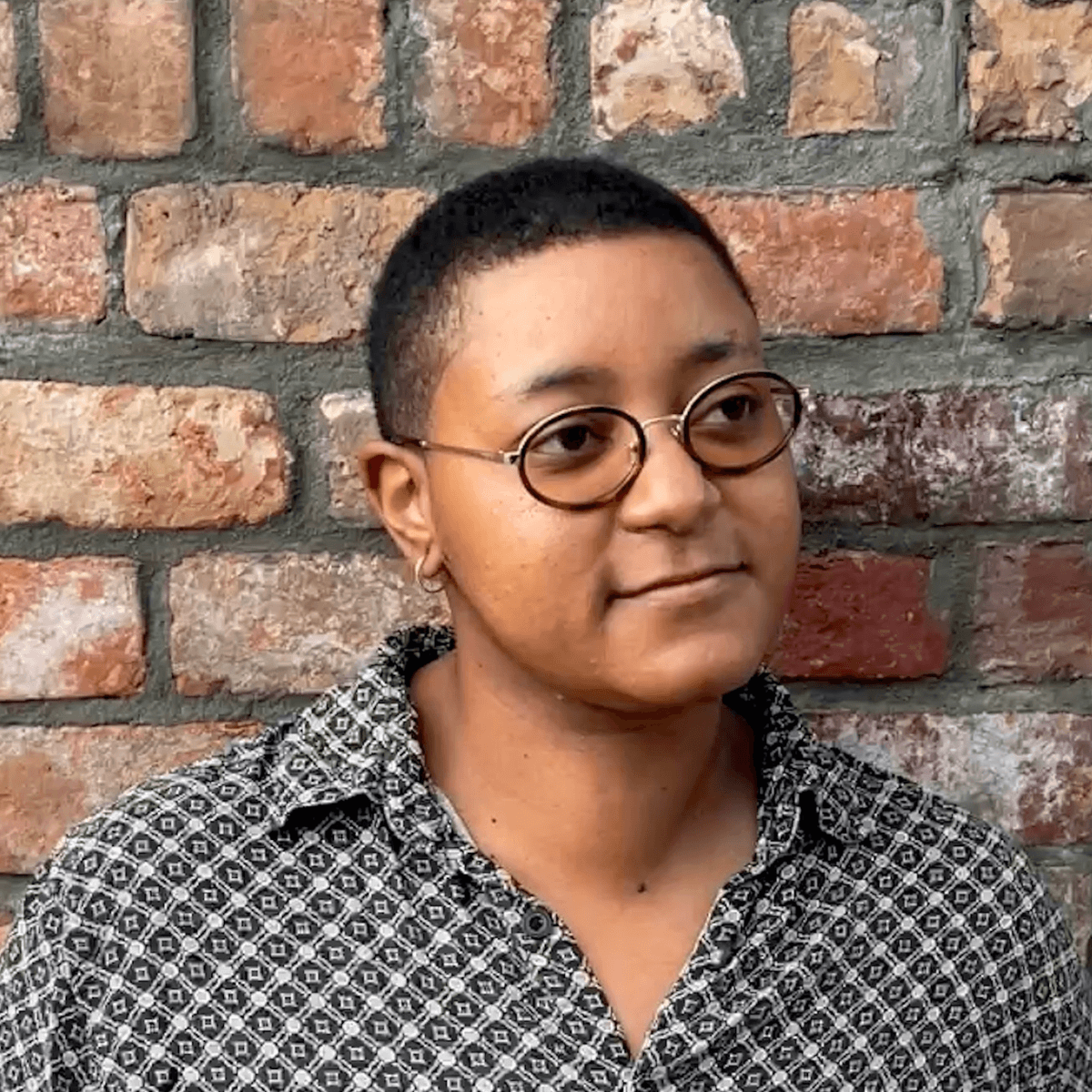
Photo courtesy of the panelist
Ashby Combahee is a memory worker and musician in Atlanta. They are the Library and Archives Program Manager at the Highlander Research and Education Center, where they established the Southern Memory Workers Institute at the Highlander Center, a popular five-day workshop sharing skills in public history, archival preservation, documentary arts, and political strategy. Their work focuses on the documentation and preservation of Southern grassroots liberation movements in the United States, with particular focus on reproductive, queer, and food justice movements. They are a cofounder of Georgia Dusk, a Southern liberation oral history, and a research fellow with the Folk Education Association of America focused on resourcing Black craftspeople and Black-led folk schools. Ashby holds a BA from Bennington College and an MA in Community Education from Goddard College.
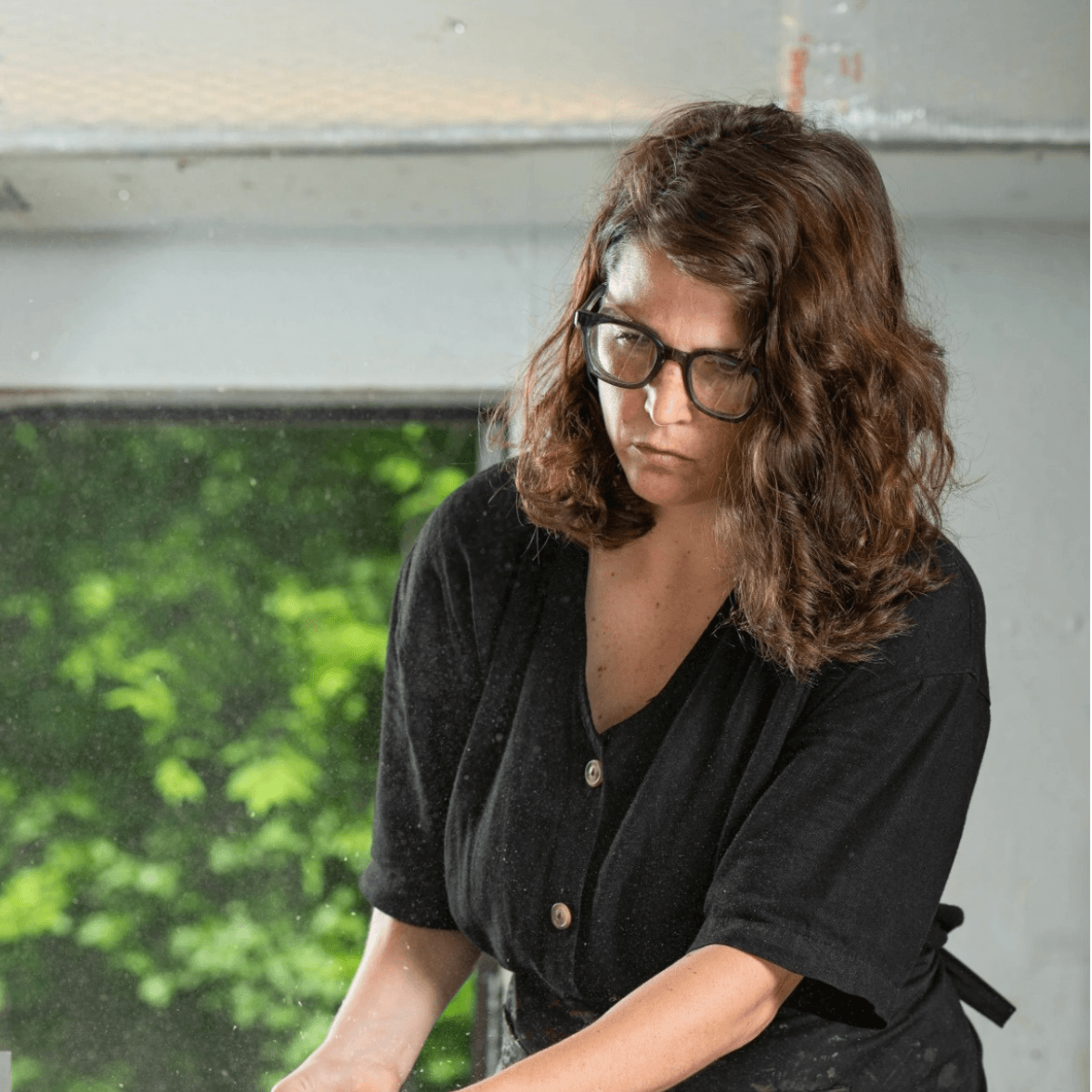
Nina Cinelli
Ellie Richards creates assemblages, installations, and furniture that explore how domestic objects shape our relationships to place, labor, and one another. Working at the intersection of sculpture, craft, and design, she transforms familiar forms and materials into experiences that invite curiosity, interaction, and reflection. Her work is held in the permanent collections of the Museum for Art in Wood and the North Carolina Museum of Art, and has been exhibited at Winterthur Museum, Mint Museum, Center for Craft, SOFA Chicago, and the Society of Contemporary Craft. She has completed Windgate-funded residencies at the Center for Art in Wood, San Diego State University, and University of Wisconsin–Madison, as well as the three-year Resident Artist Program at Penland School of Craft. Richards is a lecturer at California State University, Long Beach and leads ER Studio, her Los Angeles–based design practice, from LA Woodshop.

Photo courtesy of the panelist
Lindsay Rogers is a ceramic artist, educator, and arts advocate living in Western New York. Her studio practice continuously interweaves her interests in ceramic material science, craft, and sustainable agriculture. For over a decade, she has used her pottery to advocate for a more locally based, sustainable food system. This research has led to numerous publications, including magazines such as Ceramics Monthly, Bon Appétit, and Martha Stewart Living, as well as a wide range of collaborations with food photographers, chefs, farms, and other food-focused organizations. She served as an Associate Professor and Head of the Ceramics Area at East Tennessee State University and as Chief Programs Officer at Arrowmont School of Arts and Crafts before returning to full-time studio practice in 2026.

close
✕

The Community Foundation of Western North Carolina is a trusted partner in philanthropy. We help donors and nonprofits achieve their charitable goals, now and forever.